How Garment Seams Affect Fit and Drape
Learn how garment seams affect fit and drape, spot pulling or twisting, and decide what to ask a tailor before requesting an alteration or repair.
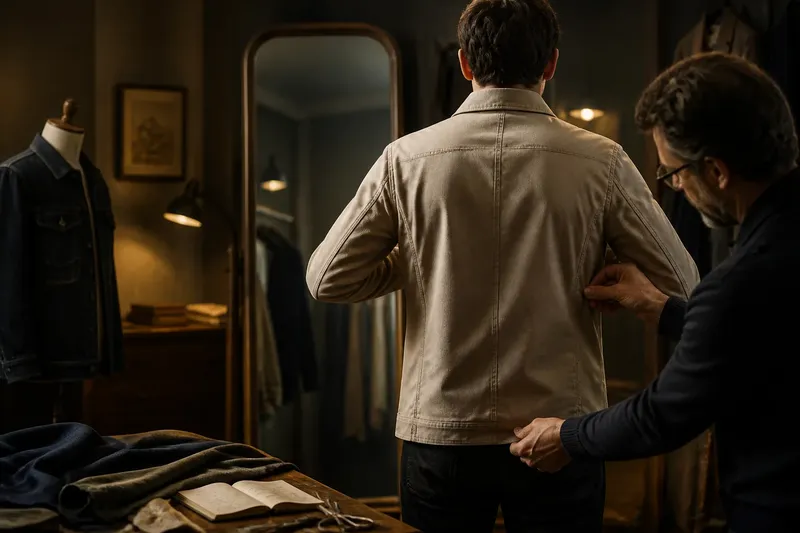
You lift a jacket from its hanger and notice one sleeve has turned slightly towards the front. Garment seams can help explain the twist, though fit, grain, cut and construction all affect how cloth hangs. A seam joins pieces of fabric; its position and direction can also reveal where the garment is under tension or where extra cloth has nowhere to settle.
Seams are useful clues, not quality verdicts. A plain seam can suit a design, while an elaborate finish can be misplaced or poorly executed. Start by noticing where the cloth changes direction and how the seam behaves when the garment is worn.
Inspect the garment while it is being worn
Put it on over the kind of layer you normally wear beneath it. Stand naturally rather than holding a fitting-room pose. Look at the side seams, shoulder seams, sleeve seams, darts and panel joins. Their paths vary by design, but a sudden bend, diagonal pull or persistent twist can indicate tension or surplus fabric.
Move gently. Raise your arms, sit, then let them fall again. A seam that looks straight when you stand still may shift as the garment accommodates movement. Notice whether the cloth returns to its earlier position. Fabric naturally folds at joints; the more useful clue is a repeated distortion tied to one area or action.
Check the front, back and sides. A side seam that swings forwards may reflect fit or balance, but it may also be part of the cut. Compare both sides and look for a matching design feature before deciding something is wrong.
Diagonal pulls show where the cloth is under tension
Lines radiating from a seam or fastening usually mean the cloth is being drawn towards a point. At the underarm, a restrictive sleeve seam or armhole may limit movement. Across the back, pulling may come from a narrow fit, a sleeve that limits reach, or panels joined at an awkward angle.
Ease the garment into place without tugging. Check that a lining, strap or underlayer is not caught. If the pulls remain, try the same movement with the garment unbuttoned. A visible change suggests that closure or available ease may be involved, rather than a stray crease.
On trousers or a skirt, diagonal lines near the crotch or hip can have several causes, including the rise, room through the seat, and the way the side or inseam sits. Letting out one seam may not solve the problem. Alteration options depend on the construction and the allowance inside it; a tailor can assess whether a local adjustment makes sense.
Twisting can come from grain as well as fit
A side seam that spirals towards the front or back can make a garment look off-centre. Check the fabric grain: threads generally run in the intended direction, though some designs deliberately angle the cloth. A panel cut or joined askew can encourage rotation. The seam may be straight and securely sewn yet still affect the garment’s hang.
Turn the garment inside out. Check whether the seam allowance is pressed consistently and whether the seam line wanders. Look for a twisted lining or a pocket bag pulling on the outer layer. These are different problems, even if each makes a seam seem to travel.
Say you have a cotton shirt whose left side seam rolls towards the front after you move. You find no lining, the seam is smooth inside, and the front panel appears to rotate with it. You compare it with a similar shirt that hangs straight, then describe the movement to an alterations specialist. The resulting assessment may distinguish a construction twist from a fit issue; it does not mean the shirt can necessarily be corrected.
Bulges and ripples point to different kinds of strain
A bulge beside a seam can mean the joined pieces are not lying flat. Curved seams around a bust or hip must follow a shaped line. If the curve is too abrupt for the cloth, or the garment is tight, the seam may pucker or lift. Sewing or pressing can also cause ripples.
Check whether the distortion appears on both sides and whether it changes when the garment is unfastened. If it relaxes, tension from the closure or fit may be involved. If it remains in the same place while the garment is off, construction or pressing may be responsible. Neither clue identifies the cause on its own, but both help you describe the problem.
Darts remove fullness so cloth can follow the body. If a dart ends too soon or points towards the wrong place, it may create a crease or pointed effect. Its position matters more than its presence. Altering a dart can change the garment’s balance, so do not unpick it casually.
Seam types describe a method, not a verdict
A plain seam joins two fabric edges, often with the raw allowances inside. It is common in shirts, dresses and trousers, and can lie unobtrusively when pressed well. A French seam encloses the raw edges, which can suit lighter fabrics. A flat-felled seam folds and secures the allowances, creating a visible ridge often used on workwear and denim. These names describe how edges are treated, not whether a garment will fit or last.
Panel seams shape a garment across a larger area. Princess seams, for example, run through the front or back and can replace darts, creating a continuous curved line. A yoke seam across the upper back or shoulders divides the garment into sections that may have different grain directions or functions. Neither seam type, by itself, proves anything about workmanship.
Inspect whether stitching follows a steady line, whether fabric is puckered, and whether the seam allowance lies without bulky knots or caught layers. Consider what the garment is meant to do. A visible, reinforced seam may suit a hard-wearing jacket; the same ridge may be unwelcome on a light blouse. Chasing the most complicated finish is not worth the effort if the garment hangs comfortably and its interior is tidy enough for its purpose.
Use these checks to decide what to do about a seam
- Observe whether a side seam shifts in the same direction on both sides; if it does, compare the design and cut before seeking a repair, but if only one shifts, show that side to an alterations specialist.
- Observe whether diagonal pulls remain when the garment is unfastened; if they ease, describe the closure or fit as a possible cause, but if they remain, ask for an assessment of the cut and seam placement.
- Observe whether the distortion returns after you raise your arms and relax them; if it does, point out the movement to a tailor, but if it does not, treat a single crease as less urgent and wear the garment normally.
- Observe whether a ripple remains while the garment is off; if it does, ask a repairer to inspect the sewing or pressing, but if it lies flat, check how the garment sits when worn before arranging work.
- Observe whether the lining or pocket bag pulls against the outer cloth; if it does, show the caught or twisted layer to a repairer, but if it does not, look for grain or fit as another possible source.
- Observe whether stitching has separated or a thread is loose; if it has, ask for a repair suited to the fabric, but if the seam is intact, avoid opening it just to test a theory.
- Observe whether the garment moves and sits as you want it to; if it does, leave a harmless design feature alone, but if it restricts movement or repeatedly twists, describe the exact action and affected area to a tailor.
What should you check when a seam looks wrong?
Does a side seam need to hang vertically?
Often it hangs close to vertical on a simple garment, but cut, drape and design can alter its path. Compare both sides and assess the garment in motion before treating a slant as a defect.
Can a seam be altered to fix pulling?
Sometimes, if there is enough seam allowance and the problem is local. Pulling may instead come from overall balance, a sleeve or a dart, so ask an alterations specialist to inspect it before work begins.
Why do seams pucker after washing?
Different layers may shrink or respond to washing differently; sewing tension or pressing can also cause puckering. Check the care label and maker’s instructions, then see whether the distortion settles after the garment is dry and gently smoothed.
Does a French seam mean the garment is better made?
No. It encloses raw edges neatly and suits some fabrics and designs, but it is not right for every cloth or use. A well-executed plain seam may be the more appropriate choice.
Describe the problem before asking for an alteration
Explain what happens rather than diagnosing it: “the side seam rotates forwards when I reach” is more useful than “the seam is wrong”. Bring the garment and, if possible, wear it with your usual underlayer. Show the movement that triggers the problem and point out where the cloth pulls or folds.
A loose thread or a small area of separated stitching may be straightforward to repair, but the right thread and method depend on the cloth and seam. Do not cut into a lining, dart or shaped panel to test a theory. If a seam carries tension or the material is delicate, ask a tailor or repairer to assess it.
Sometimes a garment’s hang is simply a consequence of its cut. A dropped shoulder, angled panel or generous sleeve can shift seams away from familiar positions without being faulty. The useful question is whether it moves and sits as you want it to. When you inspect garment seams this way, you can distinguish a design choice from a problem worth describing and get more relevant advice.