Before the Modern Suit: How Tailored Dress Took Shape
Before the modern suit, court dress favoured display while changing public settings encouraged quieter tailoring. Learn how coats, breeches and trousers reshaped formal dress.
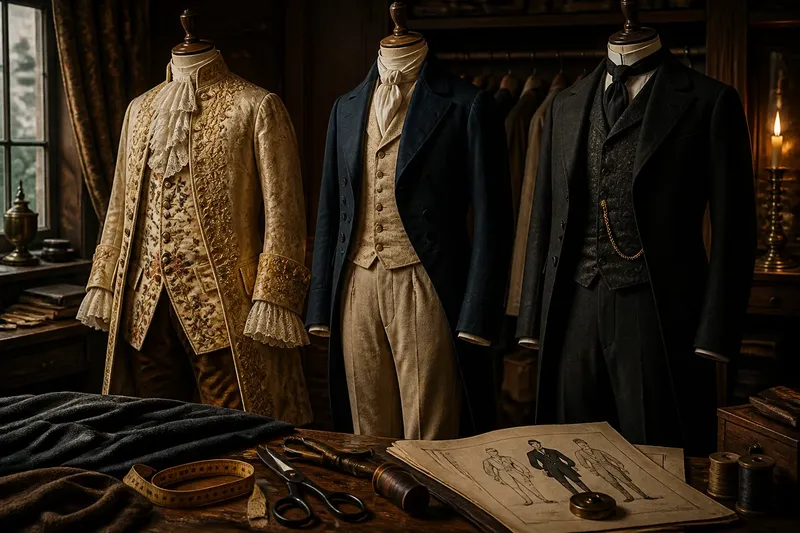
A courtier fastening a richly decorated coat over a waistcoat would have looked markedly different from a nineteenth-century clerk in a dark, tailored jacket. Before the modern suit, men’s dress changed unevenly across Europe, shaped by local customs, court fashions and the needs of particular occupations.
Men wore coats, waistcoats and breeches before the suit
In parts of western Europe during the seventeenth and eighteenth centuries, formal male dress often combined a long coat, waistcoat, shirt and knee-length breeches. Stockings, buckled shoes and a cravat or neckcloth completed the outfit. Wigs were worn in some settings and periods, but were neither universal nor a permanent feature of men’s dress.
Silk, embroidery, lace and elaborate buttons could make an outfit conspicuous. The materials and labour involved helped distinguish wealthy wearers, though the meaning of a garment depended on its setting. Court dress, professional clothing and everyday wear were not interchangeable categories.
Court display mattered, but it was not the whole story
At many European courts, clothing helped make rank and access visible. Ceremonies, court attendance and patronage could give dress a public role, but their importance varied between courts and across time. Clothing also communicated standing in other places, including towns, workplaces and religious settings.
It is too neat to say that political authority simply left the court and handed its influence to merchants. Commercial and professional groups became more visible in some places, while older courtly practices continued. The balance differed by country, class and occasion.
Access to fine clothes was uneven. A richly ornamented outfit required costly materials and skilled work; a plainer tailored garment could also require resources for good cloth, fitting and upkeep. Restraint did not automatically mean modest means.
Quieter tailoring developed through changing tastes and settings
In eighteenth- and nineteenth-century Britain, men’s public clothing increasingly included darker, less ornamented coats, alongside more elaborate forms that remained in use for particular occasions. This was not a single, universal turn away from decoration. The pace and character of change varied across Europe and among social groups.
Changing ideals of masculine respectability formed part of this history. In some British professional and urban settings, a sober coat and neat accessories could suggest self-command and propriety. That association was neither universal nor fixed; people continued to use colour, cloth and detail to signal taste and status.
Distinction did not disappear. Fine wool, a clean shirt, a well-shaped collar or a carefully tied neckcloth could still mark differences in means and care. The emphasis shifted in some contexts towards cut, fit and finish, rather than relying so heavily on surface ornament.
Coats and trousers changed the silhouette
Over time, some coats became shorter and less rigid, while waistcoats altered in length and prominence. Breeches remained in use in certain settings even as long trousers gained ground in public dress. The change was gradual, not a clean handover from one garment to another.
Tailoring shaped the body through the garment’s shoulders, waist and sleeves. As trousers became more common with coats, they made a more continuous outline than knee breeches and stockings. Neither the cut nor the combination was fixed: proportions changed with fashion and occasion.
The matching suit emerged gradually
There was no single moment when someone invented the modern suit. Coordinated jackets and trousers became more familiar over time, while waistcoats continued to feature in many outfits. Later, the two-piece suit made the jacket and trousers the central matched pair.
A suit generally means tailored pieces made from the same or closely coordinated cloth and intended to be worn together. Conventions have varied, but the relationship between the pieces matters. A jacket and unrelated trousers can be smart dress without forming a suit.
Tailoring served public life beyond the court
A tailored coat could suit several kinds of public appearance, with a change of shirt, waistcoat or neckcloth shifting its tone. That flexibility mattered in settings where people moved between work, visits and formal occasions. It did not make one outfit suitable for every person or event.
Imagine a fictional shopkeeper in a British town who owns a dark wool coat and matching trousers, chosen for supplier meetings and an evening gathering. He wears a plain waistcoat and neckcloth to meet a supplier, then changes to a more formal waistcoat and a carefully tied neckcloth for the gathering. The observable result is a change in formality while the tailored base remains the same; the trade-off is that the outfit suits both settings only if their expectations are reasonably similar.
What questions do readers ask about the suit’s origins?
Did one person invent the modern suit?
No single person produced the complete form in one act. The garments and conventions developed gradually, and the path differed by place and period.
Did waistcoats disappear when suits became common?
No. Waistcoats remained part of many formal outfits as coordinated jackets and trousers became more familiar. Their prominence changed, and later two-piece suits made them optional.
Why did trousers replace breeches?
Long trousers gained ground as tastes and conventions of public dress changed. They also created a more continuous outline with a coat, but breeches persisted in some settings.
Could a plain suit still signal wealth?
Yes. Fine cloth, skilled tailoring and careful upkeep could communicate resources without conspicuous decoration. The message depended on who wore the suit and where.
The suit’s plainness was another form of design
The modern suit was not simply a court costume with its decoration removed. It developed through different changes in tailoring, public dress and social convention, with older forms continuing alongside newer ones. Its apparent simplicity rests on choices of cloth, cut and coordination.
Before the modern suit, men’s formal clothing could make occasion and rank visible through ornament and distinct layers. The tailored ensemble offered another way to appear composed across public settings, though it never erased differences in access or taste. Its quieter outline was not an absence of meaning; it made meaning less dependent on decoration alone.